Interview-style coding question
An interview-style coding question asks you to explain an approach, write code, analyze tradeoffs, and handle edge cases.
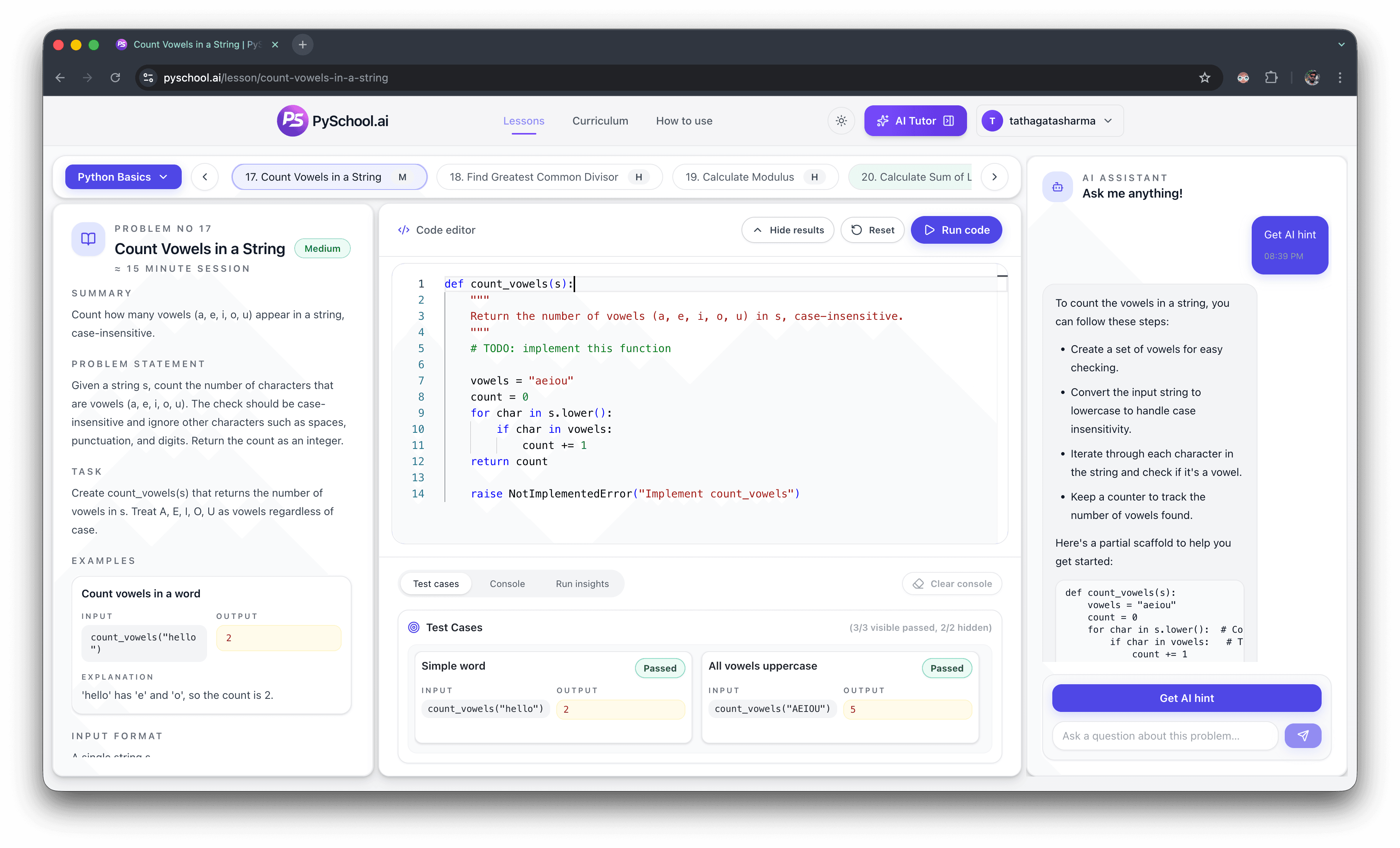
Python interview questions practice
This page organizes Python interview-style practice by pattern. It does not promise outcomes; it gives you a focused way to practice reading prompts, choosing an approach, writing code, and checking edge cases.
Focus
Pattern recognition, edge cases, and clean Python solutions
Foundation layer
Loops, lists, strings, and functions before hard prompts
Core groups
Arrays, strings, stacks, linked lists, trees, recursion, DP
Expectation
Practice support, not a guarantee of interview results
Editorial trust
DSA and interview pages are curated by pattern so learners can see prerequisites, grouped practice targets, and realistic practice expectations before moving into full curriculum lessons.
See the PySchool.ai editorial policy for how practice content is generated, reviewed, tested, and updated.
Direct answer
Python interview questions practice should focus on repeatable problem-solving, not memorized answers. Warm up with loops, lists, strings, and functions, then practice arrays, hash maps, stacks, linked lists, trees, recursion, and dynamic programming by pattern. For each question, explain brute force, code a correct version, and test edge cases.
An interview-style coding question asks you to explain an approach, write code, analyze tradeoffs, and handle edge cases.
A brute-force solution is the simplest correct approach, often useful before optimizing with a better data structure.
Pattern recognition means seeing whether a problem matches counting, two pointers, stack matching, recursion, or another known approach.
Best exercises
Common mistakes
After solving, write why the chosen data structure removes repeated work or simplifies state.
Explain the direct approach first so the optimized version has a clear comparison.
Mix foundation, interview-core, and review problems so syntax and reasoning improve together.
Learner questions
Practice by pattern, explain the brute-force idea, code the simplest correct version, then test edge cases before optimizing.
Lists, strings, dictionaries, functions, loops, recursion, stacks, trees, and dynamic programming are the most common foundations.
Not at first. Build correctness and explanation quality before adding timed sessions.
Yes. They build the syntax and problem-reading habits needed before harder DSA prompts.
Beginner foundation
Interview practice is easier to sustain when the basics are not fighting you. Start with a few public foundation links, then move into grouped full-curriculum prompts.
Iteration
Use a loop to visit each item before solving array-style prompts.
Array totals
Practice accumulation, one of the most common DSA building blocks.
List foundations
Review list scanning, filtering, and transforming before harder arrays.
String foundations
Prepare for character counting, traversal, and exact-output prompts.
Function contracts
Review parameters and return values before timed coding prompts.
Interview-core groups
These groups match common coding-interview practice areas. Locked exercises route to the public curriculum page, keeping this hub useful for logged-out visitors and search crawlers.
Practice group
Most Python interview practice starts here because these questions test loops, indexing, counters, and edge cases.
Hash maps
Count character frequencies, then scan for the first unique value.
Sets
Use uniqueness to simplify repeated values.
Two pointers
Reorder array values while keeping non-zero order stable.
Practice group
These questions are useful once array and string loops feel comfortable, because they add state and pointer movement.
Stacks
Match opening and closing symbols with push and pop behavior.
Linked lists
Rewire pointers while preserving access to the remaining list.
Two pointers
Use fast and slow pointers to detect repeated nodes.
Practice group
Tree questions test whether you can define a base case, choose traversal order, and combine child results.
Traversal
Practice a simple tree walk before deeper recursive prompts.
Recursive search
Return useful information from both sides of a tree.
Postorder recursion
Combine height and validity while walking upward.
Practice group
DP questions should be practiced after recursion basics, starting with memoization before table-based problems.
Memoization
Cache repeated subproblems and return consistent values.
Recurrence
Translate choices into a small state transition.
2D DP
Practice comparing prefixes with a table of partial answers.
Practice routine
Related practice paths
Group Python DSA practice by arrays, strings, stacks, trees, recursion, and DP.
Practice clean function contracts before interview-style prompts.
Build the list and array habits needed for DSA problems.
Practice traversal, exact output, and character-level logic.
Start from the broader Python practice overview.