Data structure
A data structure organizes values so code can store, find, update, or remove them efficiently.
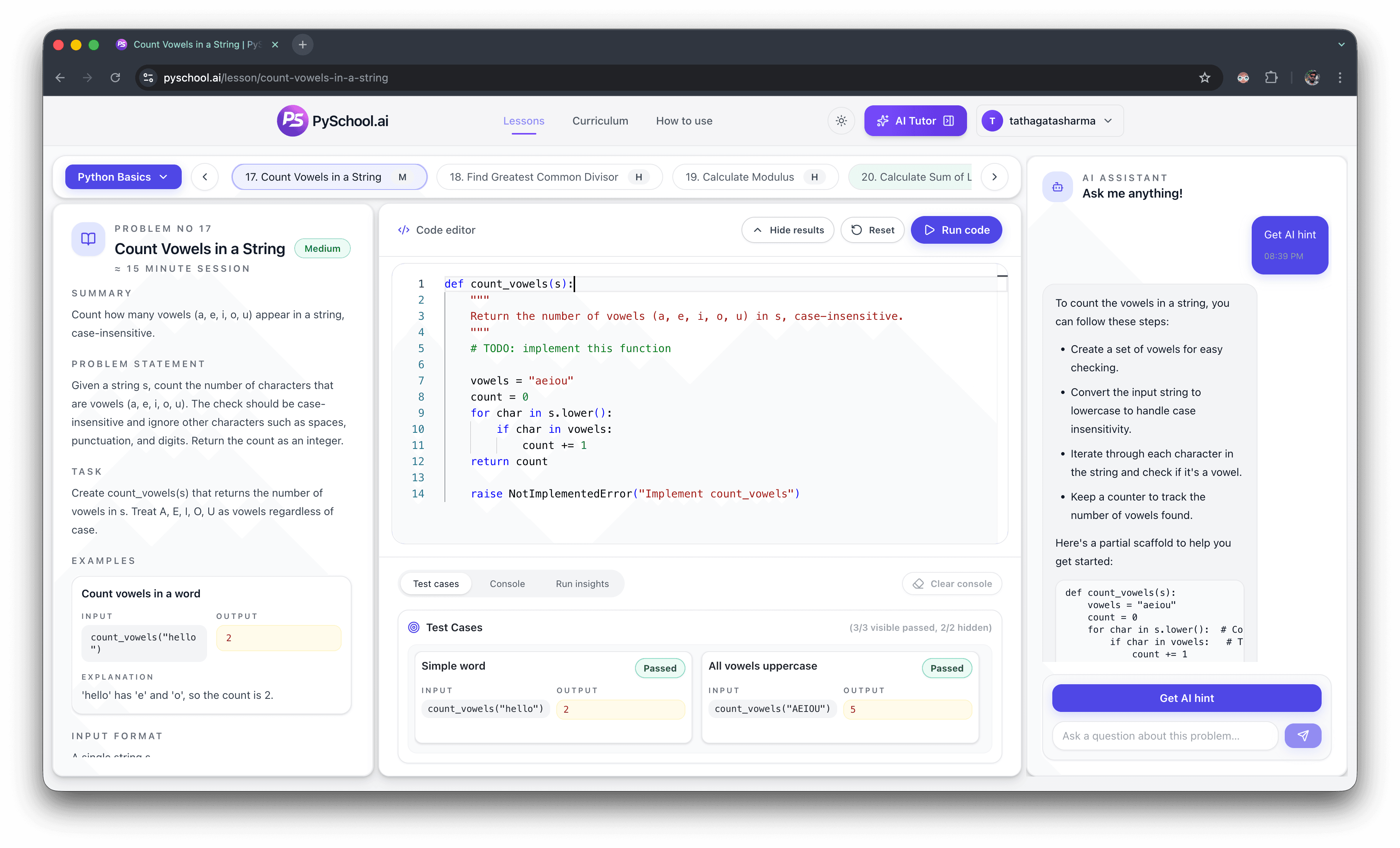
Python DSA practice
Use this page to move from Python fundamentals into data structures and algorithms. It starts with beginner foundations, then groups interview-core practice by arrays, strings, stacks, linked lists, trees, recursion, and dynamic programming.
Best for
Learners who know Python basics and need DSA structure
Pattern groups
Arrays, strings, stacks, linked lists, trees, recursion, DP
Practice path
Foundations first, interview-core problems after
Access
Public links stay public; full lessons route through curriculum
Editorial trust
DSA and interview pages are curated by pattern so learners can see prerequisites, grouped practice targets, and realistic practice expectations before moving into full curriculum lessons.
See the PySchool.ai editorial policy for how practice content is generated, reviewed, tested, and updated.
Direct answer
Python DSA practice should start after loops, lists, strings, and functions are comfortable. Begin with array scanning, counting, and string traversal, then move into stacks, linked lists, recursion, trees, and dynamic programming. The best routine is to solve the simple version first, name the pattern, then test edge cases.
A data structure organizes values so code can store, find, update, or remove them efficiently.
An algorithm pattern is a repeatable approach such as scanning, two pointers, stack matching, recursion, or memoization.
Dynamic programming solves repeated subproblems by storing previous answers and reusing them.
Best exercises
Common mistakes
Start with arrays, strings, loops, and counting before stacks, trees, or DP.
Write a brute-force or direct version first so the optimization has a clear purpose.
DSA bugs often appear at boundaries, so test empty, one-item, duplicate, and already-sorted cases.
Learner questions
Start with arrays and strings because they use the same loops, indexing, and counting habits as beginner Python practice.
No. You need reliable loops, lists, dictionaries, functions, and basic recursion before most beginner and interview-core DSA.
Practice DP after recursion and memoization make sense. Fibonacci with memoization is a better start than large table problems.
Trace one small input by hand, write down state changes, then compare each step with what your code actually returns.
Beginner foundation
DSA practice goes better when loops, lists, strings, and functions are already familiar. These links give a crawl-safe warmup path before the harder full-curriculum exercises.
Iteration
Use a loop to visit each item before solving array-style prompts.
Array totals
Practice accumulation, one of the most common DSA building blocks.
List foundations
Review list scanning, filtering, and transforming before harder arrays.
String foundations
Prepare for character counting, traversal, and exact-output prompts.
Interview-core groups
Each group is organized around a common pattern. Full-curriculum items use crawl-safe curriculum navigation while public preview and hub links open directly.
Practice group
Start with scanning, counting, and moving values. These patterns show up before most advanced data structures.
Accumulation
Return one result after scanning each list value.
Array scanning
Track the best value seen so far while reading a list.
Two pointers
Practice stable in-place style movement without losing order.
Practice group
String DSA problems test traversal, normalization, counting, and exact edge-case handling.
Foundation
Review traversal and formatting before interview-style string prompts.
Character counting
Normalize text and count selected characters with a loop.
Compression pattern
Group adjacent characters and return a compact string representation.
Practice group
Stack questions usually ask you to remember the most recent unmatched item and resolve it later.
Practice group
Linked list practice is about pointer movement, preserving references, and handling empty or single-node cases.
Pointer rewiring
Track previous, current, and next nodes without losing the chain.
Fast and slow pointers
Use two speeds to find whether a cycle exists.
Tree and list bridge
Use inorder traversal while rewiring node pointers.
Practice group
Tree practice combines recursion, traversal order, base cases, and careful return values.
Tree traversal
Visit root, left, then right with a clear recursive pattern.
Recursive return values
Return height by combining child results.
Recursive constraints
Carry min and max boundaries through the tree.
Practice group
Dynamic programming practice should start with repeated subproblems and caching before moving into larger tables.
Memoization
Cache repeated recursive calls to avoid recomputing work.
State transition
Build a recurrence from the last one or two states.
Table DP
Use a table to track the best answer for each amount.
Practice routine
Related practice paths
Use interview-style groupings without skipping fundamentals.
Build the list and array habits needed for DSA problems.
Practice traversal, exact output, and character-level logic.
Review iteration, counters, totals, and search loops.
Start from the broader Python practice overview.