Beginner Python exercise
A beginner Python exercise is a small coding prompt that practices one or two fundamentals with clear expected output.
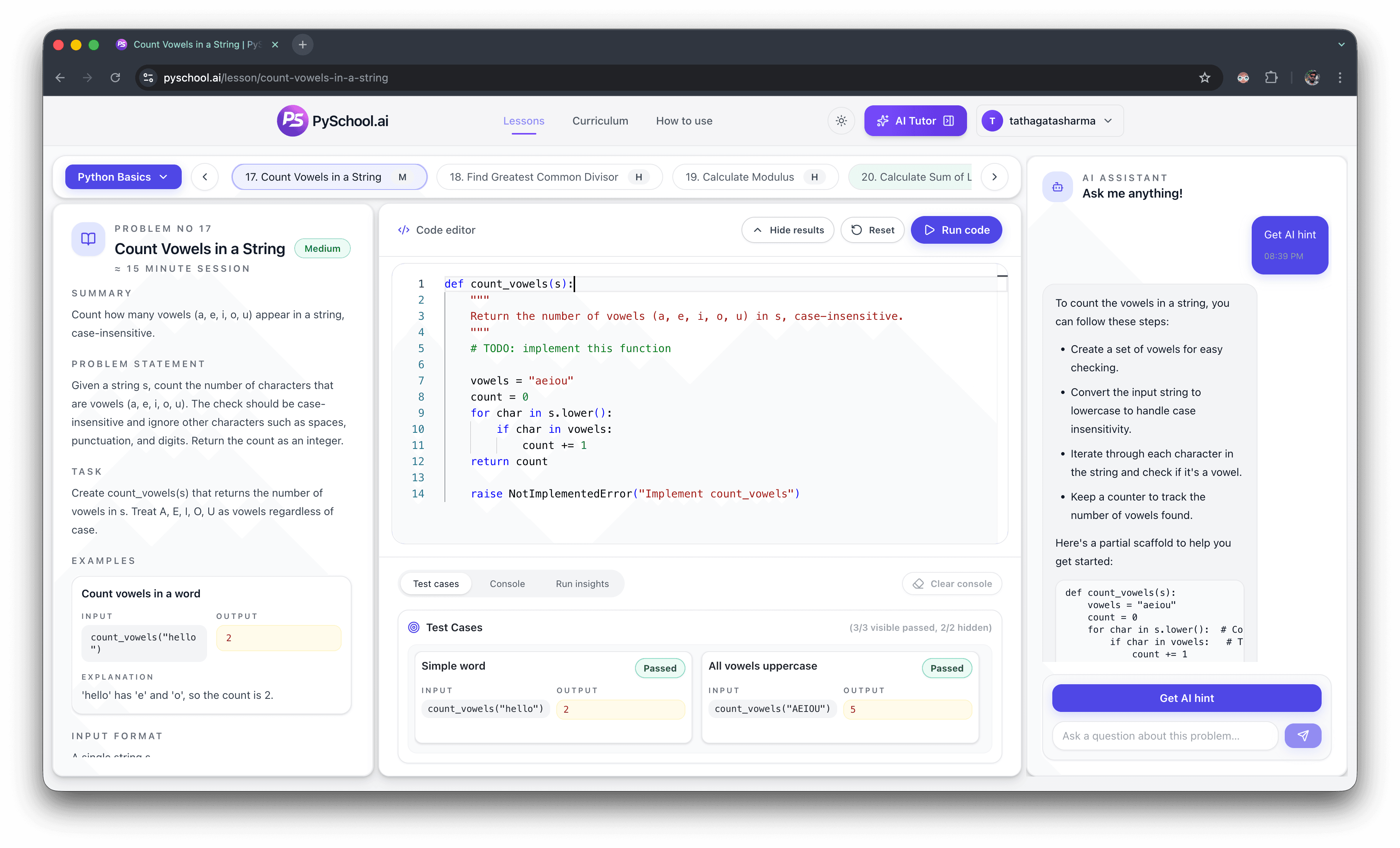
Python beginner exercises
This page is for new Python learners who need short exercises with a clear next step. Start with syntax, then move through decisions, loops, lists, and small functions using public preview lessons that open for logged-out users.
Best for
First Python practice after tutorials
Practice style
Small prompts with runnable tests
Suggested pace
Solve 3 to 5 exercises per session
Next step
Move into basics practice or the full curriculum
Editorial trust
Beginner hubs are reviewed against the public lesson catalog so the linked exercises match the stated topic, open as public practice pages, and support a clear path from basics into the curriculum.
See the PySchool.ai editorial policy for how practice content is generated, reviewed, tested, and updated.
Direct answer
Python beginner exercises should start with short, runnable prompts for variables, strings, type conversion, conditionals, loops, lists, and small functions. The best path is not memorizing answers. It is solving one focused task, running tests, reading the failure, and repeating the same pattern until basic Python syntax and problem reading feel automatic.
A beginner Python exercise is a small coding prompt that practices one or two fundamentals with clear expected output.
A visible test is an example check learners can run to compare their code against the expected result.
Prompt reading means identifying the input, output, rule, and edge cases before writing code.
Best exercises
Common mistakes
Practice variables, conditions, loops, and functions first so harder prompts do not hide basic errors.
Write a first version, run tests, and use the failure message before looking for help.
Group exercises by concept so each session reinforces one habit before adding another.
Learner questions
Start with variables, strings, type conversion, if statements, simple loops, list totals, and small functions.
Three to five focused exercises is enough for one session if you run tests and fix mistakes yourself.
No. It is better to memorize the routine: read the prompt, predict output, write code, run tests, and debug.
Move to DSA after loops, lists, strings, and functions feel comfortable on small prompts.
Practice plan
A beginner Python exercise should be small enough to finish, but specific enough to teach a real habit. If every prompt asks for several ideas at once, it becomes hard to tell whether you are stuck on syntax, logic, input, or the shape of the function.
The lessons below are grouped so you can practice one layer at a time. Write the code yourself before using hints, run the visible tests, then change one detail and run again. That routine matters more than memorizing answers because it trains you to read a prompt, predict the output, and fix the exact line that is wrong.
Lesson groups
Step 1
These warmups keep the task deliberately small. You will name values, store text, and convert between common types. Do these first if you still pause on quotes, assignment, or turning input into a number.
Step 2
Conditionals are where Python starts to feel like problem solving. These exercises make you choose between cases, order your checks, and return the exact result expected by the tests.
Conditionals
Use modulo and if statements to make a simple decision.
Branching
Handle three possible cases with clear condition order.
Comparisons
Use equality and greater-than checks to return the right result.
Strings
Compare text forward and backward to test a simple pattern.
Step 3
Lists and loops are the first place many beginners get lost. Start by visiting each item, then practice totals and counts before moving to filtering or list transformations.
Loops
Walk through each list item in order and produce output.
Accumulation
Keep a running total while a loop visits numeric values.
Counting
Track how many items a list contains without relying on shortcuts.
Filtering
Return only list values that match a condition.
Step 4
Once syntax feels less fragile, move the same ideas into functions. These problems help you use parameters, return values, and simple comparisons without adding advanced DSA concepts too early.
Functions
Write a reusable function with parameters and a return value.
Return values
Use a parameter to build predictable text output.
Function logic
Combine comparisons inside a function body.
Free preview vs full access
The lesson links on this page were selected because they are public preview URLs that currently return 200 for logged-out users. That means search engines and new learners can open the lesson page without being redirected to login.
Full access still matters once you want the complete curriculum, more advanced lessons, and the full AI help experience. Treat these beginner exercises as the open entry point, then use the curriculum when you want the ordered track and module view.
Open selected beginner lessons and practice in the browser before signing in.
Unlock the broader lesson sequence, premium practice, and full AI assistance.
Related practice paths
Use the broader hub for topic practice, DSA, and interview-style problems.
Review core syntax, collections, functions, and input handling.
Use a question-bank format for warmups and interview prep foundations.
Browse the complete learning path, modules, and free preview lessons.