Basic Python coding question
A basic Python coding question is a small programming task that checks one or more fundamentals with examples and expected output.
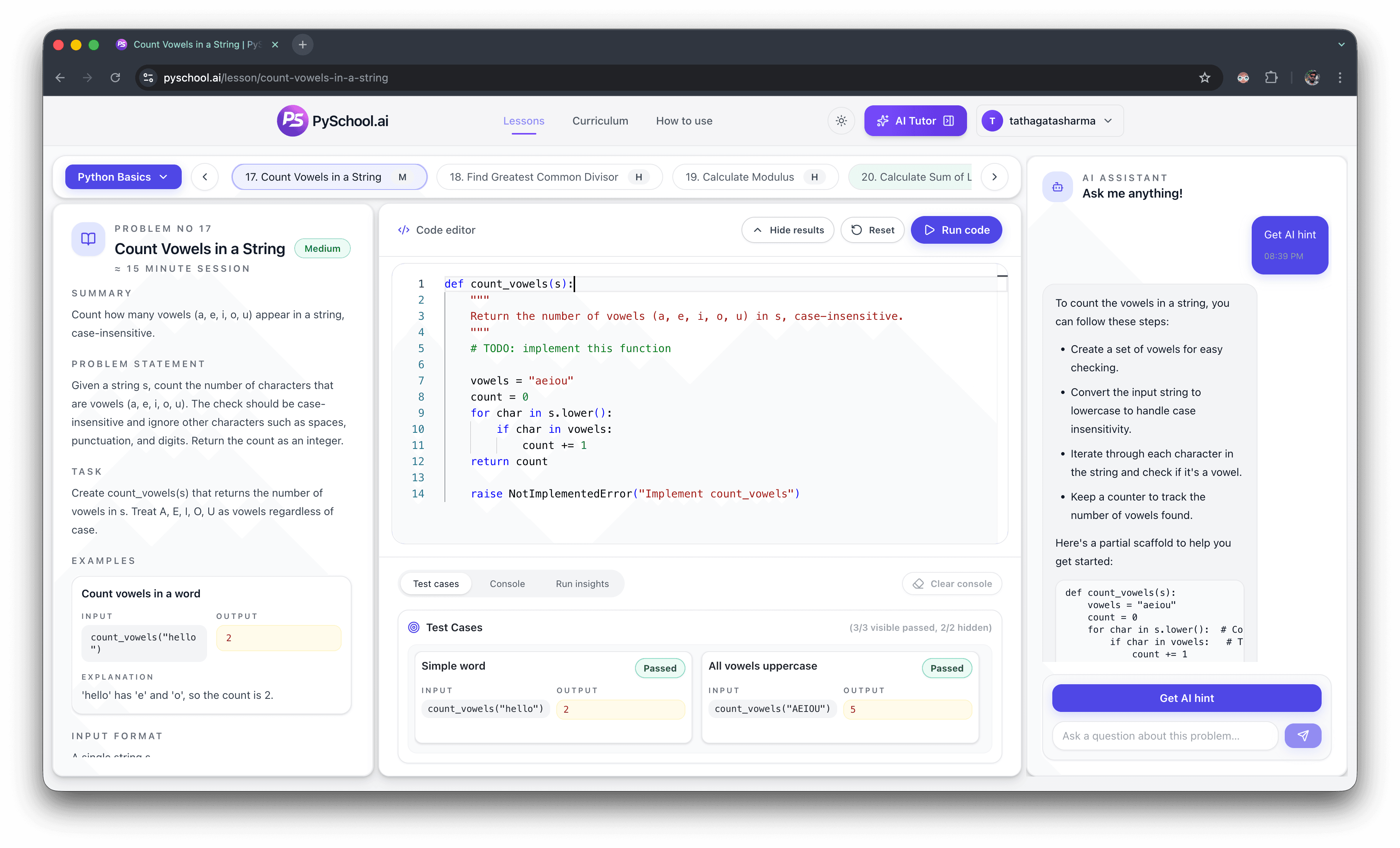
Basic Python coding questions
Use this page like a question bank for Python fundamentals. Each linked prompt is meant to be solved in code, not just read as an answer, so it is useful for warmups, placement prep, and early interview foundations.
Question level
Beginner and fundamentals
Best use
Warmups, review, and early interview prep
Answer style
Write code and pass tests in the browser
Coverage
Values, branches, loops, collections, functions
Editorial trust
Beginner hubs are reviewed against the public lesson catalog so the linked exercises match the stated topic, open as public practice pages, and support a clear path from basics into the curriculum.
See the PySchool.ai editorial policy for how practice content is generated, reviewed, tested, and updated.
Direct answer
Basic Python coding questions are short prompts that test whether you can turn fundamentals into working code. Good question practice covers variables, branches, loops, lists, dictionaries, functions, and input safety. Do not only read solutions; write the code, run examples, fix failures, and explain the rule your answer follows.
A basic Python coding question is a small programming task that checks one or more fundamentals with examples and expected output.
An edge case is an unusual but valid input, such as zero, empty text, equal values, or a missing key.
A question bank groups practice prompts by topic so learners can review and compare patterns.
Best exercises
Common mistakes
Use the browser editor to run tests and confirm the answer works on examples.
Keep the exact function name and parameters so the test runner can call your solution.
After one question passes, solve a similar one with a changed condition or input type.
Learner questions
Even or odd, compare two numbers, count list items, sum list values, validate input, and return a greeting are good examples.
They are useful for early foundations. They do not replace DSA, but they prepare the syntax and problem-reading habits DSA needs.
Practice by topic first. Random practice is more useful after you can recognize each basic pattern.
Write down the failed input, the expected output, your output, and the exact rule your code missed.
Practice plan
Many lists of basic Python coding questions show the final answer too quickly. That can feel productive, but it does not prove you can turn a prompt into working code when the exact wording changes.
The better routine is simple: read the question, name the input and output, write the first version, run visible tests, then fix edge cases. The prompts below are grouped from easiest to more structured so you can build that routine without jumping straight into hard DSA.
Lesson groups
Question set 1
These questions check whether you can represent data correctly. They are intentionally short because a clean answer here prevents confusion in longer problems.
Question set 2
Branching questions ask your code to choose. Practice even or odd, sign checks, maximum values, and simple text patterns until the condition order is obvious.
Conditionals
Use modulo and if statements to make a simple decision.
Branching
Handle three possible cases with clear condition order.
Comparisons
Use equality and greater-than checks to return the right result.
Function logic
Combine comparisons inside a function body.
Strings
Compare text forward and backward to test a simple pattern.
Question set 3
Collection questions are the next step after syntax. These prompts ask you to iterate, count, slice, filter, transform, and look up values with a dictionary.
Loops
Walk through each list item in order and produce output.
Accumulation
Keep a running total while a loop visits numeric values.
Counting
Track how many items a list contains without relying on shortcuts.
Lists
Build a list from a numeric range and return the expected values.
Indexing
Read from the front and back of a list with confidence.
Slicing
Use slice boundaries to return the part of a list you need.
Dictionaries
Map names to values and return structured lookup data.
Dictionary lookup
Avoid missing-key failures by returning a fallback value.
Question set 4
Most real coding questions expect a function. Finish with prompts that make you define a function, return a value, validate input, and handle failure cases predictably.
Functions
Write a reusable function with parameters and a return value.
Return values
Use a parameter to build predictable text output.
Input validation
Check input before using it in a calculation.
Errors
Handle division edge cases without crashing the program.
Parsing
Convert numeric text and return a safe fallback for bad input.
Free preview vs full access
Every lesson link on this page was checked as a logged-out public URL before being used. That avoids the SEO problem of sending crawlers or new learners from a public hub into a login redirect.
Some harder lessons still belong behind the full-access curriculum, and that is fine. This page is meant to own the basic question intent first, then guide learners into the wider Python practice hub and curriculum when they are ready for more depth.
Open selected beginner lessons and practice in the browser before signing in.
Unlock the broader lesson sequence, premium practice, and full AI assistance.
Related practice paths
Use the broader hub for topic practice, DSA, and interview-style problems.
Start with short beginner exercises before moving into larger topics.
Review core syntax, collections, functions, and input handling.
Browse the complete learning path, modules, and free preview lessons.