Python practice
Python practice means writing code for focused prompts, running tests, and improving the answer through feedback.
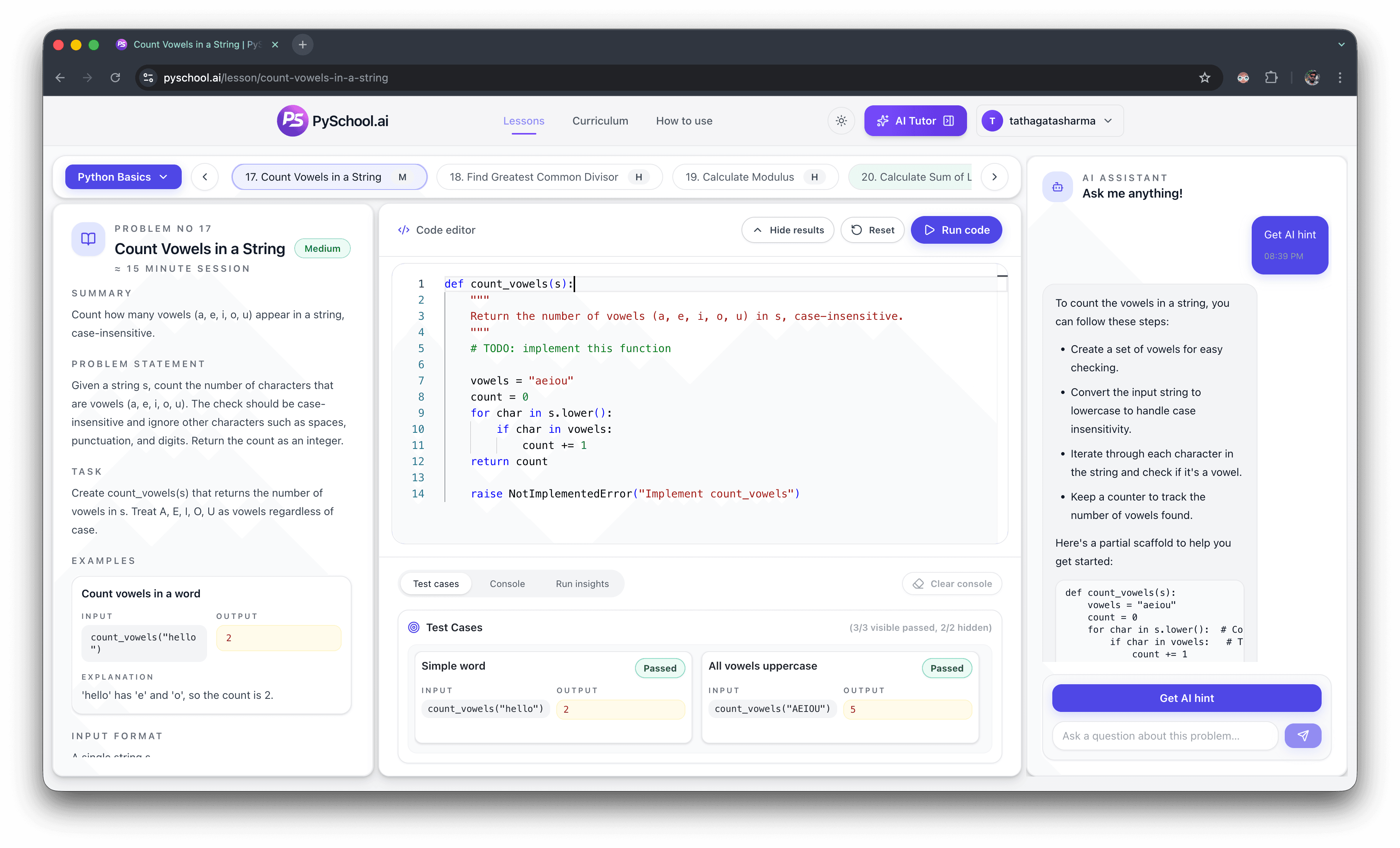
Browser-based Python coding practice
Use this hub to move from Python basics to hands-on coding exercises, topic drills, DSA practice, and interview-style problems. Each practice lesson gives you a prompt, starter code, examples, visible tests, and a browser editor.
Beginner-first
Start with variables, strings, and if statements
Hands-on
Write code in the browser and run tests instantly
Topic-based
Practice loops, lists, strings, functions, and input
Interview-ready
Build toward arrays, stacks, search, trees, and DP
Editorial trust
The main Python practice hub is curated from public lesson previews, topic hubs, DSA practice paths, and curriculum-safe lesson links so learners can choose an appropriate next exercise.
See the PySchool.ai editorial policy for how practice content is generated, reviewed, tested, and updated.
Direct answer
The best way to practice Python online is to solve small runnable exercises first, then group practice by topic: variables, strings, conditionals, loops, lists, functions, DSA, and interview patterns. Use visible tests to check each answer, fix one failure at a time, and move to harder problems only after the core pattern feels repeatable.
Python practice means writing code for focused prompts, running tests, and improving the answer through feedback.
A coding exercise is a prompt with expected behavior, examples, and checks that confirm whether the solution works.
Topic-based practice groups similar problems together so one concept becomes repeatable before the next concept is added.
Best exercises
Common mistakes
Build fluency with variables, loops, lists, strings, and functions before DSA or timed interview practice.
Use tests to discover the exact failure, then revise the answer yourself before checking hints.
Choose one topic per session so each exercise reinforces the same mental model.
Learner questions
Use a broad practice hub, then move into focused pages for beginner exercises, loops, lists, strings, functions, DSA, and interview questions.
Start with variables, strings, type conversion, and conditionals, then move into loops, lists, and functions.
Use browser-based exercises with a built-in editor and tests so you can write and run code directly from the lesson page.
Move to DSA when loops, lists, strings, dictionaries, and functions are comfortable on small coding prompts.
Search-tested practice paths
These pages are the current non-branded SEO opportunities from Search Console. They give learners focused paths for Python basics, loops, for-loop exercises, and string practice problems before moving deeper into the curriculum.
Basics
Practice type conversion, conditions, lists, dictionaries, functions, and input checks.
Open pathLoops
Use for loops to count, sum list values, search, filter, and work with range.
Open pathFor loops
Solve ordered for-loop drills for direct iteration, totals, range, and enumerate.
Open pathStrings
Practice exact output, reversal, palindrome checks, vowel counts, and traversal.
Open pathFocused practice clusters
These long-tail clusters are built for specific searches like for-loop exercises, list filtering, string problems, and function return values. Each page gives an ordered sequence, examples, expected output, mistakes, and links into the interactive lessons.
8 exercises
Use this page when you specifically want for loop practice in Python, not a broad loops overview. The sequence moves from visiting each list item to counting, summing values, range loops, early search, enumerate, and reverse iteration.
Start with Print each list item
8 exercises
Use this page when you want list-filtering practice specifically. The sequence starts with reading and counting lists, then moves into keeping even numbers, skipping blanks, transforming items, and preserving order.
Start with Read each list item
8 exercises
Use this page for Python string exercises that are narrower than the broad strings hub. The sequence starts with storing and combining text, then moves into formatting, reversal, palindrome checks, vowel counts, blanks, and run-length encoding.
Start with Store a string
8 exercises
Use this page when you specifically need practice returning values from functions. The sequence starts with arithmetic and simple conditionals, then moves into comparisons, average, division, and modulo-style outputs.
Start with Add two numbers
Python beginner practice
If you are searching for basic Python coding questions, start here. These exercises focus on syntax, variables, strings, conditionals, comparisons, and type conversion before asking you to combine many ideas at once.
Variables
Create and name values before moving into larger programs.
Strings
Work with text values, quotes, and simple assignments.
Type conversion
Turn strings and numbers into the form your program needs.
Conditionals
Use if statements and modulo logic to branch correctly.
Comparisons
Practice greater-than, less-than, and equality decisions.
Python topic practice
Good Python practice is not random. Pick a topic, solve several problems in the same pattern, then move to the next concept once the loop, condition, or function shape feels natural.
Build the core habit of walking through a collection, keeping state, and returning the exact result.
Practice indexing, scanning, normalization, and character frequency with short text problems.
String traversal
Reverse characters with indexing or iteration.
Two-way checks
Compare a string with its reversed form.
Character counting
Normalize text and count selected letters.
Frequency maps
Compare letters after sorting or counting.
Turn small ideas into reusable functions and handle messy input without crashing.
Functions
Write a clear function signature and return value.
Return values
Use parameters to produce a predictable result.
Validation
Check input before using it in calculations.
Errors
Avoid division failures with a fallback value.
Python DSA practice
Python DSA practice works best when arrays, strings, dictionaries, loops, and functions are already comfortable. These problems introduce common interview patterns without hiding the implementation behind a multiple-choice quiz.
Arrays and scanning problems teach state tracking.
Search problems teach boundaries and invariants.
Recursion and memoization teach repeated subproblems.
Arrays
Scan numbers and return a single aggregate result.
Array scanning
Track best values while moving through a list.
Counting
Count matching items with a loop.
Binary search
Use low and high pointers on sorted input.
Stacks
Use push and pop behavior to match brackets.
Trees
Visit tree nodes in root-left-right order.
Python interview practice
Interview prep is not just harder questions. It is learning to restate the task, choose a data structure, handle edge cases, and explain why your code passes the tests. Use these problems to practice that routine.
Hash maps
Count frequencies, then scan for the first unique value.
Sets
Use uniqueness to simplify repeated values.
Two pointers
Reorder values while keeping non-zero order stable.
Dynamic programming
Cache repeated recursive work.
Full learning path
This hub is the entry point for broad Python practice intent. The curriculum keeps the same work ordered by track and module, so you can move from beginner Python exercises to topic drills and DSA without losing your place.